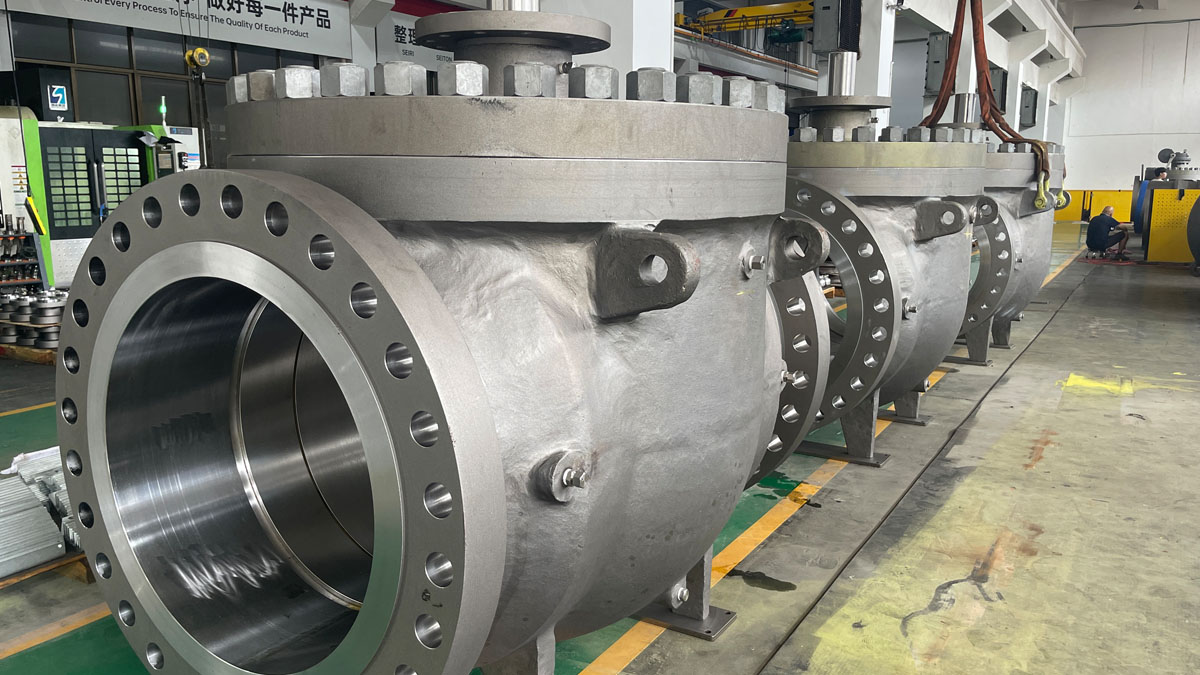


A top entry ball valve is a quarter-turn isolation valve whose ball, seats and stem are assembled through an opening in the top of a one-piece body, then closed with a bolted bonnet. That single detail — service access from above instead of from the side — is why top entry valves are the default choice on large-diameter, high-pressure pipelines where cutting a valve out of the line costs more than the valve itself.
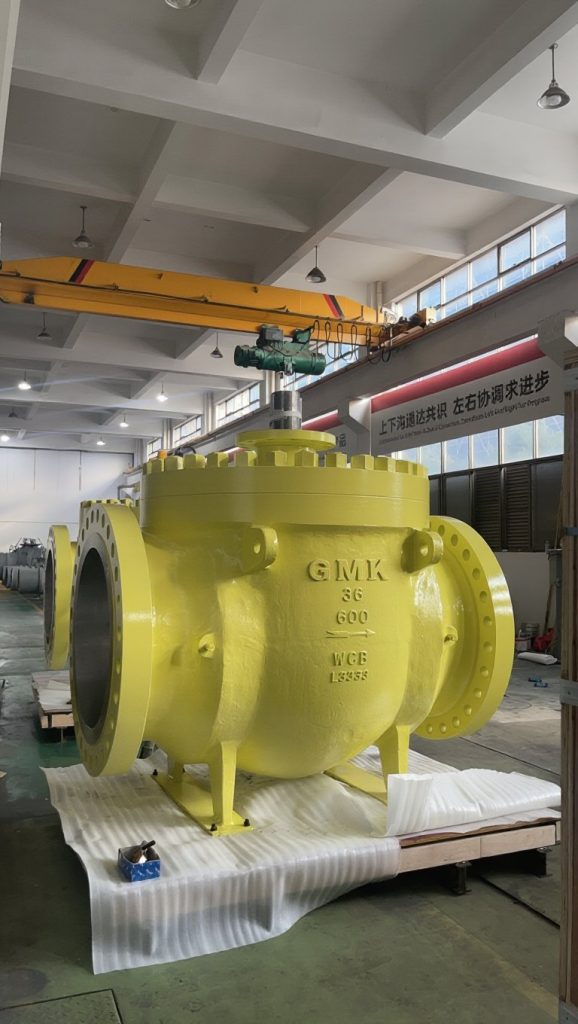
For instance, the unit in the photo below is a typical example: a 36-inch Class 600 top entry ball valve in ASTM A216 WCB carbon steel, trunnion mounted, full bore, flanged ends, built to API 6D and fitted with an electric quarter-turn actuator. As a result, everything you need to service it sits under one bonnet, directly above the ball.
Key takeaways
- A top entry ball valve has one pressure-containing joint — the bonnet — instead of two body joints on a three-piece side entry design.
- Moreover, a maintenance crew can inspect and repair the valve in line: remove the actuator, unbolt the bonnet, lift the ball assembly out. No cutting, no welding, no flange spreading.
- Consequently, above 12–16 inches and Class 300 and up, the maintenance savings usually outweigh the higher purchase price.
- In addition, large sizes are almost always trunnion mounted, with double block and bleed, emergency seat sealant injection and an anti-blowout stem.
What Is a Top Entry Ball Valve?
In a top entry design, the body is a single casting or forging, while a side entry valve is assembled from two or three bolted sections. The bore runs straight through the casting, and the top of the body carries a large, heavily bolted flange — the bonnet joint. Therefore, the ball, both seat assemblies, the stem and the trunnion bearings all go in through that opening.
Two consequences follow directly from that architecture:
- First, the pipeline never has to be broken to service the valve. Second, the seats — the parts that actually wear — are reachable from above. This is the whole point of the design, because it takes the pipe out of the maintenance critical path.
- In short, the ends of the valve carry no body-joint bolting. By contrast, a three-piece side entry valve carries two bolted body joints between the pipe flanges, and those joints add length, weight and two more gaskets to torque and monitor. Hence, a top entry body is shorter face to face and has a single joint to manage.
In addition, top entry ball valves are available in soft-seated and metal-seated versions, in full bore and reduced bore, and in sizes from a few inches up to 60 inches and beyond, although lead times lengthen sharply above 48 inches. Of course, above roughly 16 inches, they are almost always trunnion mounted.
How a Top Entry Ball Valve Works
Body and bonnet
The one-piece body carries the full pressure load as well as the pipe loads. The bonnet is a separate heavy flange carrying a large stud circle, sealed with a spiral wound or ring joint gasket because a flat gasket cannot hold this pressure class. Moreover, on big valves that stud circle can be two or three rows deep — every one of those nuts has to be torqued in a controlled, star-pattern sequence, both at assembly and after any field service. That is the one procedure that most often decides whether a repaired valve leaks or not.
Ball and trunnion bearings
On a trunnion mounted ball valve, line pressure alone does not hold the ball against the seats. Trunnion bearings fixed to the body support it top and bottom, so the ball rotates in place rather than shifting downstream under pressure. The trunnion therefore transfers line pressure into the body, not into the seat.
This matters at large sizes, because operating torque stays low enough for a compact actuator, and the seats only have to provide a sealing preload rather than resist the whole thrust of a 36-inch line at 600 psi.
Seats and sealing
Each seat is a piston-style assembly with a soft or metal sealing ring, and a spring plus line pressure provide the sealing force, because the seat only has to seal rather than carry thrust. Depending on the specification, suppliers build seats in three configurations, because each one seals differently:
- Single piston (self-relieving) — body cavity overpressure bleeds past the seat into the upstream line. This is the standard arrangement for most liquid and gas lines, because it protects the cavity without extra hardware.
- Double piston (double block and bleed) — both seats seal in both directions, so the body cavity can be bled and verified while the valve is closed. Sites specify it where the valve must act as a positive isolation point, since both seats then seal in both directions.
- Metal seats suit abrasive media and high temperature, because soft seats would be destroyed there.
Most large top entry valves also carry an emergency seat sealant injection fitting at each seat and at the stem. If a seat is damaged by debris, sealant injected under pressure restores a seal long enough to schedule a proper repair — a feature pipeline operators value more than almost any other option.
Stem and safety features
The stem passes through the bonnet and is normally anti-blowout: a shoulder on the stem bears against the bonnet so pressure cannot eject it even if the packing gland is removed. Besides, an anti-static device — usually a spring-loaded pin between stem and body — discharges static charge generated by flowing hydrocarbon. Fire-safe construction uses graphite packing and a graphite or metal gasket so that the valve still seals after a fire has destroyed the soft seats.
Top Entry vs Side Entry: What Actually Changes
This is the comparison buyers ask about most; therefore, here it is without marketing language.
| Feature | Top entry | Side entry (2- or 3-piece) |
|---|---|---|
| Body construction | One-piece body, one bolted bonnet on top | Two or three body sections, bolted at the body joints |
| Pressure-containing joints | One (bonnet) | One (2-piece) or two (3-piece) |
| Access to seats and ball | From above, through the bonnet | Through the body joint |
| Repair in line | Yes — no pipe cutting, no flange spreading | Usually no; 3-piece requires spreading the pipe flanges |
| Face-to-face length | Shorter — no body-joint flanges at the ends | Longer |
| Vertical clearance needed | High — room for a crane and a bonnet lift | Low |
| Field repair time | Typically one shift for a seat change | One to several days, plus line-breaking work |
| Purchase price | Higher | Lower |
| Best fit | Large diameter, high pressure, critical isolation | Small to medium bore, tight budget, low headroom |
Rule of thumb: below about 8 inches, a side entry valve is cheaper and perfectly serviceable, and headroom is rarely available anyway. However, from 12–16 inches upward, or anywhere the line cannot be shut down for a week, the arithmetic flips. In fact, add up the cost of draining, purging, cutting, welding, NDT, re-commissioning and lost throughput once — that number is usually larger than the price difference between the two designs.
Why Top Entry Wins on Large-Diameter Pipelines
On a 36-inch gas transmission line, a valve is not a component you take to a workshop. Instead, it is a piece of the pipeline, often 3–5 tonnes, sitting between two large flanges in a station or a pig trap area. As a result, everything about the maintenance strategy has to work around that reality.
- No line breaking. In particular, there is no cutting, no welding, no hot work permit, no NDT of a new weld, and no re-hydrostatic test of the spool.
- One gasket to control. Only the bonnet joint has to be made up and leak-tested after a repair, instead of two body joints.
- Shorter installed length. Likewise, a compact face-to-face dimension reduces the footprint of the station and the load on pipe supports.
- Better access on congested skids. Furthermore, seats come out from the top; there is no need for lateral space to swing a wrench on a body joint buried between pipe racks.
- Full traceability of the pressure boundary. Finally, with a one-piece body, the casting quality, wall thickness and material certificate cover the whole pressure envelope.
Design Features Worth Specifying
Indeed, two valves that look identical from the outside can differ by a factor of two in service life. These are the features that decide it:
- Trunnion mounted ball with top and bottom bearings, for low torque and stable sealing at large sizes.
- Double block and bleed (DBB) capability, with a body cavity drain or vent.
- Emergency seat and stem sealant injection fittings.
- Anti-blowout stem and anti-static device.
- Fire-safe design tested to API 607 or API 6FA.
- Fugitive emission packing qualified to ISO 15848-1 where the site has a methane leakage target.
- NACE MR0175 / ISO 15156 materials for wet sour service.
- ISO 5211 mounting pad so a gearbox, electric or pneumatic actuator can be fitted without an adapter plate.
- Lifting lugs and support feet on large sizes, so the valve can be slung safely and does not load the pipe flanges with its own weight.
- Drain and vent plugs at the lowest and highest points of the body cavity.
Inside the 36-Inch Class 600 Unit in the Photo
For instance, the valve pictured is a good illustration of how these features come together at the large end of the range. The body carries stencilled marks for size, pressure class, material grade and a traceability number — 36, 600, WCB — so the pressure boundary can be traced back to its heat number and test record.
| Parameter | Specification |
|---|---|
| Type | Top entry, trunnion mounted ball valve |
| Size / pressure class | 36 inch / ASME Class 600 |
| Body material | ASTM A216 WCB carbon steel |
| Design standard | API 6D (ASME B16.34 rating basis) |
| End connection | Flanged raised face, ASME B16.47 Series A / B drilling |
| Face-to-face | Per API 6D / ASME B16.10, long pattern |
| Bore | Full bore (reduced bore available) |
| Temperature range | -29 °C to 425 °C (WCB, per ASME B16.34) |
| Operation | Electric quarter-turn actuator, ISO 5211 mounting, manual override |
| Testing | Shell and seat test to API 598 / ISO 5208 |
| Fire safety | API 607 / API 6FA (on request) |
Also note the two support feet cast into the bottom of the body. Because the valve can weigh several tonnes at this size, that mass would otherwise hang on the pipe flanges and the adjacent welds. Similarly, the lifting lugs on the body shoulders serve the same purpose on the handling side. If you are specifying a top entry ball valve this large, put both items in the data sheet explicitly — they are frequently treated as options and then regretted on site.
Typical Applications
- Long-distance oil and gas transmission lines — section isolation, pig trap and scraper launcher service.
- Compressor and pump stations — main line block valves, station isolation.
- Storage tank farms and terminals — tank farm manifolds, loading and unloading headers.
- Refineries and petrochemical plants — critical isolation on process and utility headers.
- Power generation — cooling water, fuel gas and auxiliary systems.
- Large-diameter water transmission — trunk mains and pump station isolation, in ductile iron, carbon steel or stainless steel.
In-Line Repair: The Procedure
This is the sequence a maintenance crew follows to change seats without taking a top entry ball valve out of the line, and the order matters because each step depends on the one before. It is the reason the design exists.
Changing seats without breaking the line
- Isolate and depressurise. Close the upstream and downstream isolation, lock out, drain and vent the body cavity through the drain plug, and confirm zero pressure. Purge if the medium is flammable or toxic, because the body cavity can trap gas.
- Remove the actuator. Disconnect the electric or pneumatic actuator at the ISO 5211 interface and lift it clear. Protect the coupling and the mounting face, since a damaged keyway will misalign the new actuator.
- Mark and unbolt the bonnet. Mark the bonnet orientation against the body, then release the studs in a cross or star pattern in several passes. On a valve this size, use hydraulic torque or a stud tensioner rather than a hand wrench, because a hand wrench cannot reach the specified preload evenly.
- Lift the bonnet assembly. The bonnet, ball and stem come out as one assembly. Check the crane capacity and the sling points first — this is the heaviest lift in the job.
- Inspect and replace. Examine the seats, sealing rings, springs and gasket, since a tired spring will leak again within weeks. Replace soft goods as a set; do not reuse a spiral wound gasket. Check the ball surface for scoring and lap or replace if required.
- Clean and reassemble. Clean the body cavity and seal surfaces, fit new seats and gasket, and lower the assembly back onto its marks.
- Torque in sequence. Tighten the bonnet studs in the specified star sequence, in at least three passes, to the manufacturer's torque values. In fact, uneven torque is the most common cause of a leaking bonnet joint.
- Test before return to service. Shell test and seat test to API 598, then cycle the valve and re-check. Then record the results.
What the procedure buys you
In short, a seat change on a large top entry valve, done properly, is a single-shift job with the line shut in. On the other hand, the equivalent job on a three-piece side entry valve means spreading the flanges, which on a 36-inch line means cutting pipe, welding in a spool, and re-testing — days, not hours.
How to Specify a Top Entry Ball Valve
Send these eleven lines to any supplier and you will get comparable quotations instead of guesswork:
- Size and ASME pressure class
- Design standard (API 6D, API 6DSS for subsea, or ASME B16.34)
- Body and trim material, plus NACE requirement if the service is sour
- Full bore or reduced bore
- End connection type and drilling (ASME B16.5 up to 24 inch, ASME B16.47 above)
- Face-to-face dimension and pattern
- Design pressure and temperature, and the operating medium
- Seat type: soft, metal, single or double piston, DBB required or not
- Fire-safe and fugitive emission requirements
- Actuation: manual gear, electric or pneumatic, with the mounting standard
- Documentation and inspection: material test certificates, test reports, drawings, ITP, third-party inspection
Common Buying Mistakes
- Comparing price without comparing scope. For example, a quotation without DBB seats, sealant injection or fire-safe testing is not the same valve.
- Ignoring vertical clearance. In other words, the valve needs room above it for a crane and a bonnet lift. Consequently, check the drawing against the actual site.
- Forgetting the support feet and lifting lugs on very large sizes, because the valve would otherwise hang on the pipe flanges.
- Ordering a soft-seated valve for a service that needs metal seats, because abrasive slurry or high temperature will destroy the inserts.
- No stem extension where the valve is buried, insulated or under a cold box, although the operator then has no way to reach the handle.
- Skipping third-party inspection on a valve that will sit in a transmission line for thirty years.
Frequently Asked Questions
What is the difference between a top entry and a side entry ball valve?
A top entry valve has a one-piece body with a bolted bonnet on top, and crews install and service its internal parts from above. By contrast, a side entry valve consists of two or three bolted body sections, and its internals come out through those body joints. In short, a crew can repair a top entry valve in line without breaking the pipeline, at the cost of a higher purchase price and a taller installation.
Can a top entry ball valve be repaired without removing it from the pipeline?
Yes — in-line repair is the main advantage of a top entry ball valve, because it keeps the pipe out of the critical path. First, isolate and depressurise the line; then remove the actuator, unbolt the bonnet, and lift the ball and seat assembly out through the top opening. The crew can then replace seats, gaskets and seals with the body still bolted between the pipe flanges.
What sizes and pressure classes are available?
In addition, manufacturers commonly produce top entry ball valves from 2 inch to 60 inch in ASME Classes 150, 300, 600, 900, 1500 and 2500, in carbon steel, stainless steel, duplex and alloy steels. As a result, the design is most economical from about 12 inch upward, where the in-line repairability starts to pay for itself.
Is a trunnion mounted ball valve the same as a top entry valve?
No — they describe different things. "Top entry" describes how the valve is assembled and serviced. "Trunnion mounted" describes how the ball sits on bearings top and bottom rather than floating against the downstream seat. In general, most large top entry valves are trunnion mounted, but side entry valves also use trunnion mounting.
Are top entry ball valves fire safe?
They can be, and for hydrocarbon service you should specify them that way, because most pipeline standards require it. A fire-safe valve uses graphite packing, a graphite or metal bonnet gasket, and a metal-to-metal secondary seal at the seats, so the valve still isolates after a fire has destroyed the elastomeric or PTFE seat inserts. In addition, require testing to API 607 or API 6FA and ask for the certificate.
What documentation should come with the valve?
At minimum: material test certificates traceable to heat numbers for the pressure-retaining parts, shell and seat test reports to API 598 or ISO 5208, a dimensional drawing, and the nameplate data. For critical lines, add a full inspection and test plan, NDT reports on welds and castings, coating reports, and third-party inspection records.
Full bore or reduced bore — which should I choose?
Choose full bore where pigging, scraping or a low pressure drop matters — most transmission lines and pig trap service. By contrast, reduced bore is cheaper and smaller for the same pressure class and is acceptable where the line will never be pigged and a modest pressure drop is tolerable. However, never mix the two on a line that has to pass a pig.
Looking for a Top Entry Ball Valve Supplier?
GMK Valve manufactures top entry ball valves from 2 inch to 48 inch in Classes 150 to 2500, in WCB, WC6, CF8, CF8M, duplex and other grades, built to API 6D and tested to API 598. Our works in Wenzhou holds ISO 9001, API 6D and CE/PED certification, and we also supply full material traceability, test reports and third-party inspection on request.
Send us your data sheet — size, class, medium, temperature and actuation — and we will then come back with a technical proposal and a drawing within two working days. Finally, see our full ball valve range or contact the GMK engineering team.